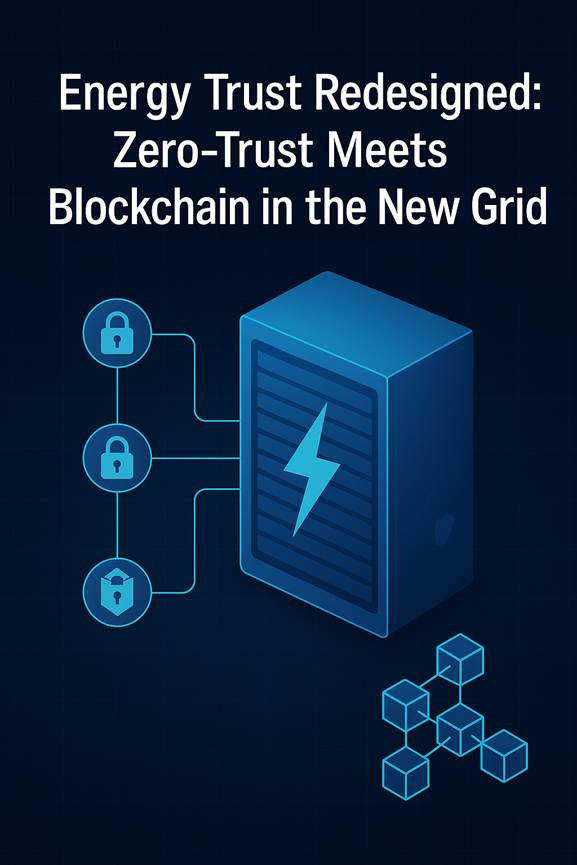
From Resilience to Proof: Why Trust Must Be Engineered
Energy systems are no longer static. What was once a collection of isolated substations and power assets is now a web of connected storage units, microgrids, and intelligent controllers. With that transformation comes an equally powerful challenge—trust. How do we ensure that every device, algorithm, and data stream within the grid can be verified, secured, and held accountable? The answer lies in combining Zero-Trust architecture with blockchain-anchored verification, transforming the grid from a fragile network into a verifiable ecosystem.
Zero-Trust changes the assumption that internal systems are inherently safe. It enforces continuous validation of identity, data, and behavior across every layer of infrastructure. For energy storage operators, this means that no inverter, battery controller, or gateway is trusted by default. Each must cryptographically prove who it is, what firmware it runs, and what actions it’s authorized to perform. When extended across a distributed energy fleet, this architecture builds digital walls of assurance around each node, limiting the blast radius of any compromise.
Turning Infrastructure into Intelligence
Blockchain technology complements this approach by serving as an immutable recordkeeper. Every policy change, firmware update, and operational command can be timestamped, signed, and recorded on a private, permissioned ledger. This audit trail ensures traceability and accountability while automating compliance with frameworks like NERC CIP and IEC 62443. The result is not more bureaucracy but transparent governance—auditors no longer rely on spreadsheets; they can verify evidence directly in the ledger.
The practical impact is profound. When an incident occurs—say, a battery management system receives a rogue command—the Zero-Trust layer immediately isolates the threat. In contrast, the blockchain layer preserves a tamper-proof record of what happened, when, and by whom. Recovery times shrink, forensics accelerate, and trust is maintained even under attack. The entire system learns from the event, improving its resilience over time.
Looking forward, the integration of AI and Zero-Trust within blockchain-secured infrastructure will push the grid toward self-governance. Smart contracts could one day enforce operational boundaries automatically—rejecting commands that violate policy, regulating energy flows according to market conditions, or validating sensor data in real time. This convergence will not just strengthen cybersecurity; it will redefine the very notion of reliability.
The future grid won’t depend on human vigilance alone. It will operate on measurable, verifiable trust—built into every watt, every packet, and every decision. The convergence of Zero-Trust and blockchain isn’t just an upgrade to our security model; it’s the blueprint for a resilient, intelligent energy ecosystem where transparency and autonomy are the new currency of reliability.
See Onclave Networks and Secure Energy for information on TrustedGridTalk as an example.
References
Ogborigbo, J. & Gadah, J. N. “Implementation of Zero Trust Architecture for Cybersecurity in Distributed Energy Resources (DERs): A Systematic Review.”
This paper examines how Zero‐Trust can be adapted for energy storage and distributed energy systems.
Uddin, S. S. et al. “Next-generation blockchain enabled smart grid.”
A review of blockchain architectures applied to smart grid environments, useful for your discussion of identity, traceability and audit-trail in energy systems.
Sandia National Laboratories. “Cybersecurity of Battery Energy Storage Systems.”
Focuses specifically on storage-system vulnerabilities and reinforces your link between storage fleets and Zero-Trust controls.
#ZeroTrustSecurity #BlockchainEnergy #EnergyResilience #CyberSecureGrid #TrustedInfrastructure #OnclaveNetworks
 Disruption is a Fact of Life
Leave a comment