Introduction
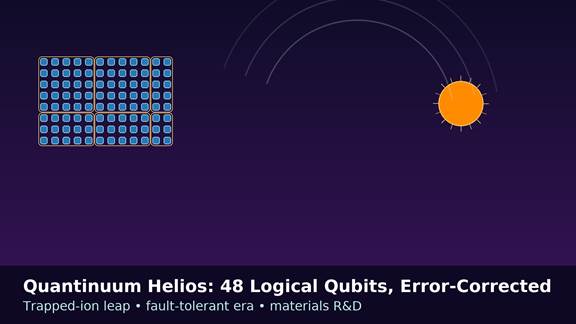
November 7, 2025 — Quantinuum this week unveiled “Helios,” a trapped‑ion quantum computer that converts 98 physical qubits into 48 error‑corrected logical qubits—an efficiency previously thought years away. Early benchmarks report single‑qubit fidelities at ~99.9975% and two‑qubit fidelities at ~99.921%, with demonstrations that error‑corrected operations can outperform uncorrected ones in real workloads. One researcher described it as “better‑than‑break‑even performance,” the inflection point where error correction finally starts paying off.
Why it matters now
- Fault‑tolerance milestone: 48 logical, fully error‑corrected qubits at a ~2:1 encoding ratio compress timelines for practical quantum use.
- Application lift‑off: simulations of superconducting materials and complex magnetism hint at near‑term breakthroughs in materials and chemistry.
- Enterprise readiness: a new Python‑based stack (“Guppy”) and real‑time control make Helios more programmable for banks, pharma, and energy.
- Ecosystem signal: investors and policymakers can now score progress in logical qubits and fidelity, not just raw physical qubit counts.
Call‑out
From qubits that drift to logic that holds: error correction goes commercial.
Business implications
For R&D-intensive sectors—such as pharmaceuticals, specialty chemicals, and energy—Helios narrows the gap between proof of concept and commercial advantage. Error‑corrected logical qubits reduce the noise penalty that has stalled scale‑up, enabling longer circuits for tasks like catalyst discovery, protein‑ligand docking, and battery materials. Financial institutions exploring portfolio optimization and risk Monte Carlo may also benefit from deeper circuits with tighter error bounds.
For cloud and software vendors, the new control stack and the Guppy programming model lower integration friction. Teams can begin to codify error-correction strategies as software patterns—compilers deciding when to switch between error-detected and error-corrected modes based on workload tolerance and budget. That creates a pricing and SLAs market: customers pay for logical‑qubit minutes the way they pay for GPU hours today.
For governments and regulators, the message is twofold: quantum advantage for certain classes of physics and optimization problems might arrive sooner than previously budgeted, and workforce pipelines must expand rapidly. Funding priorities will shift toward algorithms and middleware that translate logical-qubit capacity into domain-specific outcomes, alongside cryptographic readiness for a post-quantum world.
Looking ahead
Near term (3–9 months): early customers validate speed‑to‑insight on a handful of materials and optimization use cases; cloud providers expose Helios tiers with workload templates and guardrails. Toolchains mature around mixed error‑detected/‑corrected execution and automated circuit transpilation.
Longer term (12–36 months): logical‑qubit counts climb toward triple digits, enabling more complex chemistry and multi‑asset optimization. Expect hybrid classical–quantum pipelines to standardize (GPU+QPU co-scheduling), while procurement shifts from lab pilots to multi-year capacity commitments tied to measurable R&D milestones.
The upshot
Helios won’t crack every problem tomorrow, but it meaningfully changes the slope. When error‑corrected logic reliably outperforms bare qubits, the debate moves from “if” to “how fast.” Leaders should nominate two or three high‑value candidate problems, stand up a hybrid pipeline, and measure time‑to‑insight against classical baselines—because the curve just bent.
References
- LiveScience — “Scientists unveil Helios, a record‑breaking quantum system” (Nov 6–7, 2025).
- Wall Street Journal — “The Next Big Quantum Computer Has Arrived” (Nov 6, 2025).
- Quantinuum — “Commercial launch of Helios… 48 error‑corrected logical qubits” (Press release, Nov 5, 2025).
- arXiv — “Superconducting pairing correlations on a trapped‑ion quantum computer” (Nov 3, 2025) — simulation results on Helios.
 Disruption is a Fact of Life
Leave a comment