Introduction
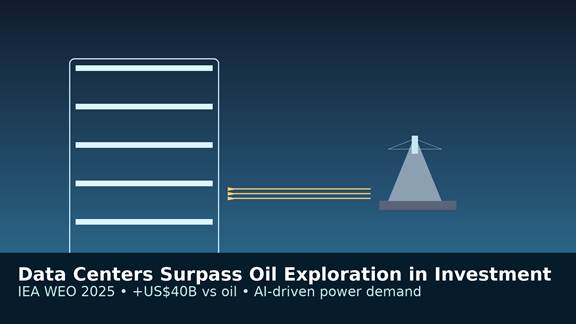
November 12, 2025 — A new International Energy Agency (IEA) analysis finds the world will invest about US$580 billion in data centers this year—roughly US$40 billion more than it will spend on finding new oil supplies. The IEA casts this as a ‘telling marker’ of the digital economy’s rise, warning that grid interconnection queues and component bottlenecks could slow critical capacity unless planning accelerates. TechCrunch, summarizing the report today, highlights the sharp growth from AI workloads and the clustering of 200‑MW‑plus facilities near major cities.
Why it matters now
- Capital flip: annual data‑center investment (~US$580B) eclipses upstream oil exploration by ~US$40B.
- AI surge: electricity demand from AI data centers could grow fivefold by decade’s end.
- Grid strain: decade‑long interconnection waits in hotspots like Northern Virginia; moratoria in some EU metros.
- Energy mix shift: renewables expected to supply most new data‑center power by 2035, with SMRs and gas filling gaps.
Call‑out
Bold pivot: compute now out‑invests crude exploration.
Business implications
For cloud providers and chipmakers, the signal is unequivocal: capacity and power are the new currency. Hyperscalers will prioritize sites with fast-track interconnections, abundant renewable energy sources, and supportive regulatory frameworks. Semiconductor roadmaps (CPUs, GPUs, memory, power electronics) must account for sustained AI demand and tighter energy‑efficiency targets.
Enterprises will experience a two‑sided market. On one side, AI services expand as capacity comes online. On the other hand, locality and timing matter: workloads may face zonal pricing, curtailment windows, or ‘bring‑your‑own‑power’ expectations. Expect more long‑term PPAs, behind‑the‑meter storage, and thermal reuse commitments in colocation contracts. Utilities and grid operators, meanwhile, will form new partnerships around transmission upgrades, flexible interconnection, and capacity-as-a-service models that reward load shifting and rapid ramping.
Looking ahead
Near term (3–9 months): accelerated siting around existing clusters; utilities publish AI‑specific interconnection playbooks; developers adopt load‑aware scheduling and model‑distillation to control energy spend.
Longer term (12–36 months): permitting reforms create fast lanes for high‑efficiency campuses; co‑located renewables, battery storage, and potentially small modular reactors (SMRs) reduce grid dependence; semiconductor packaging and memory architectures evolve to cut joules per token. Markets begin valuing ‘usable compute per kWh’ as a primary KPI.
The upshot
This is the most precise inflection point yet: capital has chosen compute. Organizations that treat power, siting, and efficiency as primary product features—not afterthoughts—will capture the next wave of AI-driven value while remaining resilient to grid constraints.
References
- International Energy Agency — World Energy Outlook 2025 (Published Nov 12, 2025).
- TechCrunch — Data centers now attract more investment than finding new oil supplies (Nov 12, 2025).
 Disruption is a Fact of Life
Leave a comment