Introduction
In today’s technology-centric world, one disruptive security event is enough to ripple across multiple industries—and today we’re seeing exactly that. From airports grinding to a halt to production lines stopping in their tracks, the message is clear: when the digital backbone weakens, the physical world reacts. For leaders in software security, especially those focusing on healthcare and energy sectors, the implications are profound.
What happened
Two major incidents dominate the headlines:
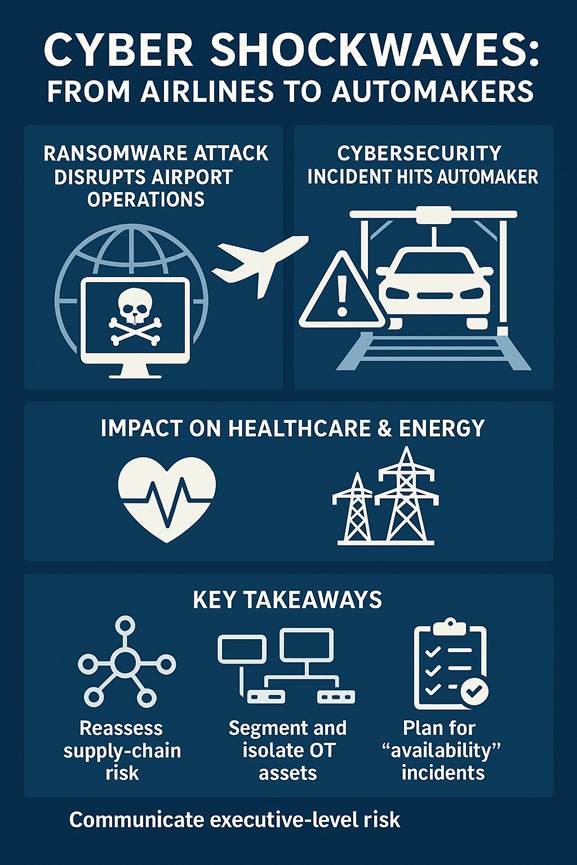
- A ransomware attack on a software supplier disrupted airport operations across Europe. The supplier’s check-in/boarding software was compromised, forcing airlines at several major hubs to revert to manual processing. IT Pro
- A global automaker, Jaguar Land Rover (JLR), reported a severe cybersecurity incident affecting its IT systems, forcing a production halt at a major plant and impacting both manufacturing and retail channels. The Record from Recorded Future
These two events span different sectors (aviation and automotive) but converge on the same theme: the fragility of trust and availability in modern, digitally mediated operations.
Why this matters
For software security in healthcare & energy
- Both industries depend heavily on OT (operational technology) and critical infrastructure. If the aviation or automotive world can be disrupted by ransomware or systemic cyber-incidents, so can hospitals, clinics, grid operators, DER (distributed energy resource) controllers, and microgrids.
- Traditional defenses are no longer sufficient. These incidents highlight that supply-chain vulnerabilities (software providers, third-party components) and the interconnected nature of systems are prime targets.
- Zero-trust architectures, microsegmentation, and secure software supply chains are no longer optional—they are mission-critical. For energy and healthcare, where safety, compliance, and uptime matter, this is especially true.
For disruption as a broader theme
- These incidents are textbook examples of what the business literature calls “disruptive innovation”—but in a negative sense. A disruption not of markets so much as operational continuity. Wikipedia+1
- The ability of a malicious actor to cause an operational shock shows that risk is shifting from purely data confidentiality to service availability and safety.
- The acceleration of digital/physical convergence means that cyber incidents can produce physical effects: grounded planes, halted assembly lines. That increases regulatory, financial, and reputational stakes dramatically.
Key takeaways for you
- Reassess supply-chain risk: If a software provider in aviation triggered global counters, imagine what a compromised firmware platform or ICS (industrial control system) vendor might do in your sector.
- Segment and isolate OT assets: The line between IT and OT is blurring. Ensure that even if IT is compromised, OT cannot be trivially leveraged as a pivot.
- Plan for “availability” incidents: It’s not just about data theft—plan for service interruption, recovery, manual fallback, and resilience in the face of disruption.
- Communicate executive-level risk: These kinds of headline events have board-level exposure. Be ready to translate technical vulnerabilities into business continuity concerns.
- Test incident-response end-to-end: Simulate not just a malware outbreak but a supplier software failure, recovery path, alternate operations, and downtime cost modelling.
Impact on Healthcare & Energy
- Healthcare: A cyber-event that halts non-critical systems might now escalate into halted appointments, diagnostic equipment inoperative, jeopardized patient safety. The recent events show that disruptions are cascading.
- Energy: If a DER controls vendor is hit or a SCADA provider goes offline, you could see grid segments forced into manual operation or even black-start conditions. With the drive toward distributed microgrids, the risk surface is expanding.
- Edge/Field Devices: Both sectors increasingly rely on edge devices (e.g., in-field sensors, micro-grid controllers) which often are less hardened. The attacker pivot path seen in these incidents should be a red flag.
Strategic advice going forward
- Adopt Zero Trust: For both sectors, enforcing “never trust, always verify” across devices, networks, and identities is vital.
- Continuous monitoring & anomaly detection: Not just known threat signatures, but behavior-based detection—especially for side-effects that resemble the recent incidents.
- Resilience architecture: Plan for “failure” scenarios: what happens if your software provider is hit? How do you operate manually or in degraded mode?
- Vendor risk management: Map your critical third-party dependencies and include cyber-incident triggers in your vendor risk scoring.
- Board and executive alignment: Elevate these risks into business-continuity conversations. Use analogies like grounded flights or halted factories to illustrate real-world impact.
Closing thoughts
What we’re witnessing isn’t just another cybersecurity breach—it’s a wake-up call. When the digital underpinning of industry falters, everything derived from it shows strain. For leaders in healthcare and energy—two industries where safety, compliance, and continuity are non-negotiable—the stakes are higher than ever.
Take today’s disruptions as a case study. Use them to sharpen your strategy, harden your infrastructure, and ensure that when the next wave hits (and it will), you’re built not just to survive—but to remain operational.
 Disruption is a Fact of Life
Leave a comment