Introduction
Today, disruption isn’t coming from huge models or data centers — it’s creeping in through the smallest devices. A wave of announcements shows that tiny sensors, embedded AI, and ultra-low-power edge computing are quietly reshaping how we collect data, monitor systems, and act in real time. The future may be less about massive compute and more about smart everywhere — in devices, infrastructure, and the environment.
Why It Matters Now
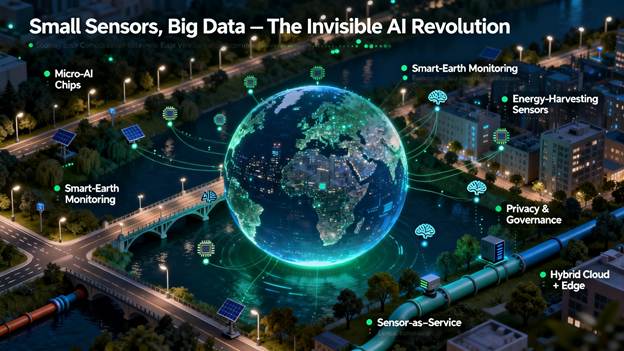
- Several hardware startups rolled out next-generation micro-AI sensor chips — ultra-low-power processors capable of running advanced inference directly on sensors, without needing cloud connectivity. That lets devices sense, analyze, and react independently.
- Governments and municipalities in multiple regions announced plans to deploy AI-enabled environmental sensors — for air quality, water contamination, traffic flow, and infrastructure health — signaling a shift toward pervasive “smart-earth” monitoring.
- Research labs announced breakthroughs in energy-harvesting edge devices that power sensors from ambient sources (solar, vibration, heat), suggesting a path to sustainable, long-lived deployments with minimal maintenance.
- Meanwhile, privacy and data-governance regulators flagged new concerns: with sensors everywhere capturing environmental, biometric, and behavioral data, the line between utility and surveillance is rapidly blurring.
These developments matter because they mark a pivot: AI’s next wave isn’t centralized and heavy, it’s distributed, embedded, and often invisible.
Call-Out
The next big AI revolution may not live in data centers — it may live inside everyday sensors.
Business Implications
- Embedded-AI hardware becomes a new battleground. Companies that produce or integrate sensor-level AI in IoT, smart cities, and industrial monitoring will gain a strategic edge over purely cloud-based AI vendors.
- Data becomes massively distributed — and decentralized. Rather than centralizing storage and inference in cloud farms, businesses may shift to edge compute models, reducing latency, bandwidth costs, and reliance on central servers.
- New business models emerge: sensor-as-a-service, infrastructure-monitoring, real-time environmental analytics, predictive maintenance for utilities and municipalities — all built on embedded-AI sensors.
- Regulation and privacy compliance become critical. Firms deploying pervasive sensors must build transparent governance, data-minimization, consent — or risk regulatory and reputational fallout.
- Sustainability and maintenance cost drop. Energy-harvesting, self-powered sensors reduce operational burden, enabling long-term deployments in remote, harsh, or infrastructure-sensitive environments.
Looking Ahead
Over the next 12–36 months:
- Widespread sensor rollout across cities and industries — from smart water grids to real-time environmental monitoring to predictive infrastructure maintenance.
- Hybrid AI architectures — a mix of cloud, edge, and embedded inference, optimized per application: latency-sensitive, privacy-sensitive, connectivity-limited.
- New privacy/data-governance frameworks — regulators and standards bodies will begin to define acceptable use, data retention, and audit requirements for pervasive sensors.
- Rise of “AI in the wild” platforms — companies offering turnkey packages for sensor deployment, data ingestion, edge inference, dashboards, and compliance tools.
- Integration with sustainability and climate tech — sensor networks for air quality, soil, energy consumption, water, emissions tracking — becoming part of global climate efforts.
The Upshot
Today’s quiet but powerful announcements suggest the next wave of disruption will be small, distributed, and ubiquitous. AI’s power is shifting from monolithic compute to embedded intelligence — everywhere, all the time. For businesses, governments, and infrastructure owners, that means rethinking architecture, compliance, and opportunity: the future isn’t just in massive data centers — it may be in the smallest edge device.
 Disruption is a Fact of Life
Leave a comment