Introduction
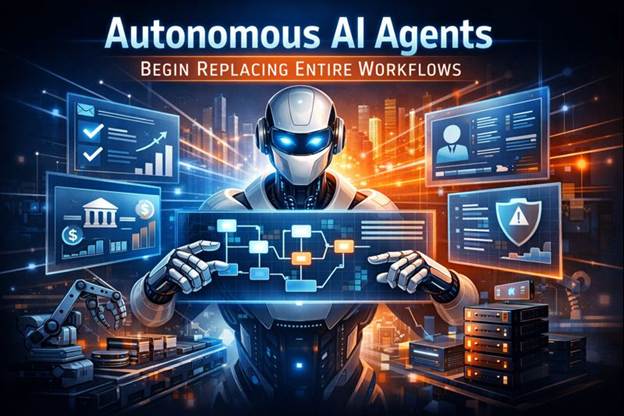
Over the past year, artificial intelligence has crossed a critical threshold. What began as tools that assisted individual tasks such as writing, coding, or summarization has evolved into autonomous AI agents capable of executing full workflows independently. In late 2024 and early 2025, enterprises began deploying these agents into production environments where they plan tasks, coordinate systems, perform actions, and verify outcomes without continuous human input. Early adopters are already reporting measurable reductions in cycle time and operational cost, signaling a structural shift rather than an incremental upgrade.
Why it matters now
This shift matters now because multiple enabling technologies have converged. Large language models have gained reliable reasoning and planning capabilities. Tool-calling frameworks allow AI systems to interact directly with enterprise software. Persistent memory enables agents to maintain context across long-running processes. Together, these elements transform AI from a reactive assistant into an active operator. As a result, entire chains of work that once required teams of people coordinating across systems can now be executed by a single agentic loop.
Call-out
“This is the moment when software stops supporting workflows and starts owning them.”
Business implications
The business impact is immediate and uneven. Functions such as customer onboarding, compliance documentation, procurement analysis, incident response, and internal reporting are being restructured to be agent-led. Organizations that deploy these systems gain speed, consistency, and cost advantages that compound over time. At the same time, traditional productivity metrics, staffing models, and management hierarchies are being challenged. Firms that continue to design operations around human handoffs risk being structurally slower than competitors that reorganize around autonomous execution.
Looking ahead
In the near term, enterprises will focus on governance, auditability, and containment as autonomous agents move into regulated environments. Oversight layers, policy constraints, and verification mechanisms will become standard components of agent deployments. Over the longer term, organizations will increasingly design processes assuming agents as the default operators, with humans serving as supervisors, exception handlers, and strategic decision-makers. This transition will reshape not only IT systems, but how work itself is defined and valued.
The upshot
Autonomous AI agents represent a fundamental operational disruption, not a feature upgrade. They collapse workflows, remove friction between tasks, and redefine the boundary between human and machine labor. The organizations that recognize this shift early and redesign accordingly will set the pace for their industries. Those who delay will find themselves competing against systems that never sleep, never forget, and continuously optimize at machine speed.
References
McKinsey & Company, The Economic Potential of Generative AI and Agentic Systems, 2024.
OpenAI, Planning, Tool Use, and Autonomous Agents in Production Systems, Technical Brief, 2024.
MIT Technology Review, Why AI Agents Are the Next Enterprise Platform Shift, 2025.
 Disruption is a Fact of Life
Leave a comment