Introduction
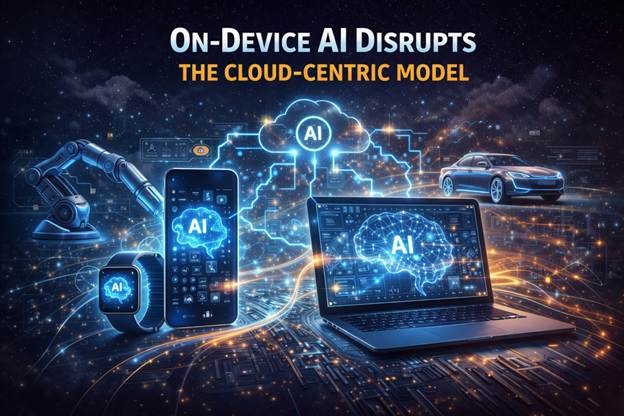
Today’s technology news highlights a decisive shift toward running advanced artificial intelligence models directly on end-user devices rather than in centralized cloud data centers. Semiconductor vendors, operating system providers, and consumer electronics companies are accelerating support for on-device large language models and vision systems, driven by new neural processing units and tighter hardware–software integration. This development comes as concerns over latency, privacy, cost, and bandwidth intensify across consumer and enterprise markets.
Why It Matters Now
The disruption lies in reversing a decade-long assumption that AI must live in the cloud. On-device AI enables inference without continuous network connectivity, eliminates round-trip latency, and keeps sensitive data local. Recent hardware advances now make it feasible to run sophisticated models on laptops, smartphones, vehicles, and industrial equipment. This fundamentally alters how AI systems are architected, deployed, and monetized.
Call-Out
On-device AI turns intelligence into a local capability rather than a remote service.
Business Implications
Cloud providers face margin pressure as inference workloads migrate toward the edge, reducing recurring compute consumption. Device manufacturers gain strategic leverage by embedding AI capabilities directly into hardware, differentiating products beyond raw performance. For enterprises, on-device AI lowers operational costs and simplifies compliance by reducing data exposure. Software vendors must adapt licensing and update models as intelligence becomes distributed rather than centralized.
Looking Ahead
In the near term, hybrid architectures will dominate, with on-device AI handling real-time tasks while the cloud supports training, coordination, and large-scale analytics. Over the longer term, fully autonomous edge systems are likely to emerge in areas such as personal computing, robotics, vehicles, and industrial control. This shift will drive new standards for model optimization, secure updates, and lifecycle management.
The Upshot
On-device AI represents a structural disruption to the cloud-first paradigm. By relocating intelligence closer to users and machines, it reshapes cost models, privacy assumptions, and competitive advantage. AI is no longer just a service delivered over the network; it is becoming a native capability embedded directly into the fabric of modern devices.
References
The Wall Street Journal, “Why Tech Giants Are Pushing AI Onto Your Devices.”
IEEE Spectrum, “The Rise of Edge AI and On-Device Intelligence.”
 Disruption is a Fact of Life
Leave a comment