Introduction
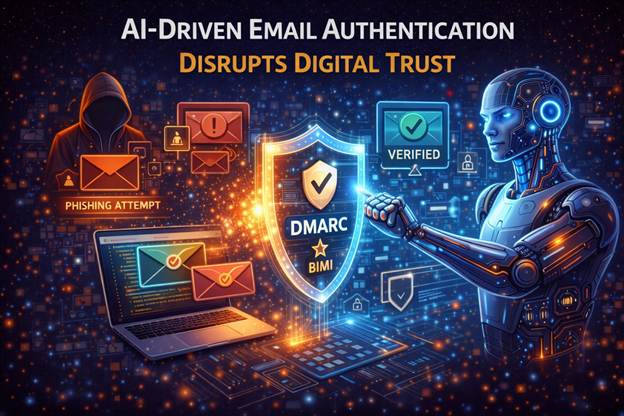
Today’s technology news highlights a sharp escalation in email authentication enforcement as major email providers expand mandatory adoption of Domain-based Message Authentication, Reporting, and Conformance (DMARC), Brand Indicators for Message Identification (BIMI), and AI-based sender reputation scoring. These changes arrive amid a surge in AI-generated phishing, business email compromise, and impersonation attacks that have eroded trust in email as a communication channel.
Why It Matters Now
The disruption lies in shifting email from an implicitly trusted medium to a cryptographically and behaviorally verified one. Traditional email relied on weak identity signals and reactive filtering. New AI-driven authentication systems continuously analyze sender behavior, domain reputation, and message intent, while DMARC and BIMI enforce verifiable sender identity. As enforcement tightens, organizations that fail to authenticate properly are seeing legitimate messages throttled or rejected outright.
Call-Out
Email trust is no longer assumed; it is algorithmically enforced.
Business Implications
Enterprises must now treat email authentication as core infrastructure rather than an optional hygiene measure. Marketing, customer communications, and internal messaging depend on verified identity to reach inboxes reliably. Organizations that fail to comply face reduced deliverability, brand damage, and increased fraud exposure. At the same time, security vendors offering AI-enhanced email defense gain strategic importance as email becomes a regulated trust surface rather than an open channel.
Looking Ahead
In the near term, expect stricter enforcement thresholds, expanded reporting requirements, and broader use of BIMI to signal verified brands visually. Over the longer term, email is likely to converge with digital identity frameworks, linking domains, devices, and users into unified trust scores. AI will increasingly mediate which messages are allowed to reach recipients at all.
The Upshot
AI-driven email authentication represents a fundamental reset of digital trust. By enforcing identity, behavior, and brand verification at scale, it changes how organizations communicate and how attackers operate. Email is evolving from an open system vulnerable to abuse into a controlled platform where trust must be continuously proven.
References
Google Security Blog, “New Email Sender Requirements to Combat Spam and Phishing.”
DMARC.org, “Why DMARC Is Essential for Modern Email Security.”
 Disruption is a Fact of Life
Leave a comment