Introduction
Today’s technology news highlights accelerating adoption of AI-generated music across streaming platforms, advertising, and content creation tools. Music generated by artificial intelligence systems is now being released at scale, used in commercial campaigns, and embedded directly into creator platforms. This shift comes as the music industry faces ongoing tension around royalties, licensing complexity, and the rising volume of digital content requiring soundtracks.
Why It Matters Now
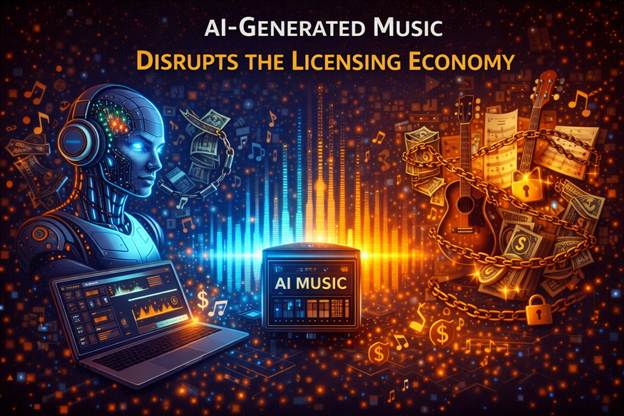
The disruption lies in bypassing the traditional music licensing value chain. Historically, music usage required negotiations involving artists, labels, publishers, and rights organizations. AI-generated music can be produced instantly, customized to context, and licensed with simplified or no royalty structures. As quality improves and distribution widens, the economic role of traditional music catalogs is being challenged.
Call-Out
Music is shifting from a licensed asset to a generated utility.
Business Implications
Content creators, advertisers, and game developers gain faster access to low-cost, customizable music without legal friction. Streaming platforms face an influx of AI-generated tracks that complicate discovery, attribution, and revenue distribution. For artists and rights holders, AI music introduces competitive pressure on background, ambient, and functional genres that have historically generated steady income. New business models are emerging around disclosure, provenance, and human-versus-AI classification.
Looking Ahead
In the near term, expect clearer labeling requirements and platform rules distinguishing AI-generated music from human-created works. Over the longer term, licensing frameworks may evolve to treat AI music as a separate category with distinct economic and legal standards. The definition of authorship, originality, and creative ownership will continue to be contested as AI-generated content becomes mainstream.
The Upshot
AI-generated music represents a structural disruption to the music industry’s licensing economy. By reducing cost, friction, and dependency on traditional catalogs, it reshapes how music is created, distributed, and monetized. As AI-generated sound becomes ubiquitous, the industry must redefine value in an era where music can be produced on demand.
References
The New York Times, “AI-Generated Music Is Flooding Streaming Platforms and Challenging Copyright,” 2024.
MIT Technology Review, “Who Owns Music Made by Artificial Intelligence?” 2024.
 Disruption is a Fact of Life
Leave a comment