Introduction
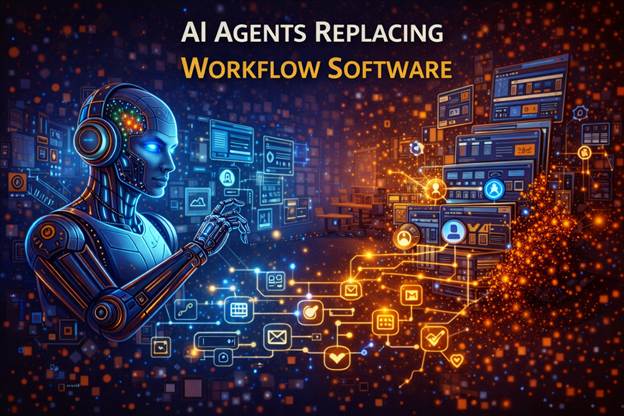
Today’s technology news reflects a growing shift away from traditional workflow and business process software toward autonomous AI agents that execute tasks directly across applications. Enterprise software vendors and AI platform providers are increasingly demonstrating agents that can observe systems, reason over objectives, and act without predefined workflows. This development comes as organizations struggle with brittle automation tools that cannot adapt to changing conditions or unstructured work.
Why It Matters Now
The disruption lies in eliminating the workflow layer itself. Traditional enterprise software relies on static process definitions, rule engines, and manual configuration. AI agents operate at a higher level of abstraction, interpreting intent rather than following scripts. As these agents gain access to APIs, credentials, and operational authority, they begin to replace entire categories of workflow orchestration, robotic process automation, and task management systems.
Call-Out
Workflows are giving way to delegated intelligence.
Business Implications
Enterprise software economics are shifting from license-heavy, configuration-driven platforms toward usage-based, outcome-oriented services. Vendors built around workflow design tools face erosion as customers demand systems that adapt automatically. For enterprises, agent-based execution reduces process latency and maintenance overhead but introduces new governance requirements around autonomy, auditability, and failure containment. The competitive advantage moves toward platforms that can safely supervise agent behavior at scale.
Looking Ahead
In the near term, AI agents will coexist with traditional workflows, handling exception paths and cross-system coordination. Over the longer term, many enterprise processes will no longer be “modeled” at all. Instead, agents will continuously interpret goals, policies, and constraints, dynamically shaping execution paths in real time. This will force a redefinition of enterprise architecture, compliance, and operational control.
The Upshot
AI agents replacing workflow software represents a structural shift in how work is executed inside organizations. By collapsing design, execution, and adaptation into a single capability, agents challenge decades of enterprise software assumptions. As adoption accelerates, the distinction between software tools and digital workers will continue to blur.
References
The Wall Street Journal, “AI Agents Begin Taking Over Enterprise Tasks Once Handled by Software,” published today.
Gartner, “From Workflow Automation to Autonomous Agents: The Next Enterprise Shift,” Special Research Note, published today.
 Disruption is a Fact of Life
Leave a comment