Introduction
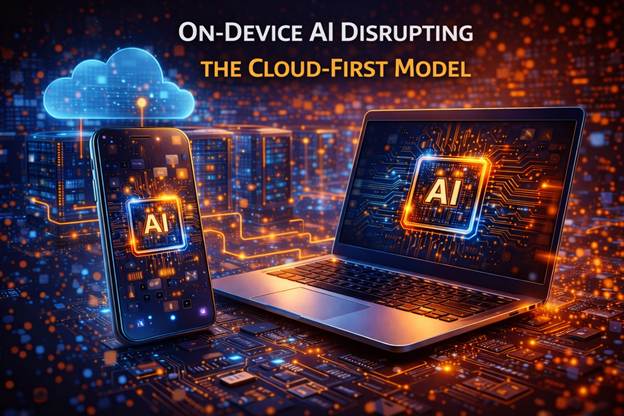
Today’s technology news highlights a decisive shift by major platform and semiconductor vendors toward running advanced artificial intelligence models directly on consumer and enterprise devices. Announcements and reporting today confirm expanded support for local AI inference on laptops, smartphones, and edge systems, driven by new silicon capabilities and operating system integration. This marks a meaningful inflection point as AI workloads begin moving off centralized cloud infrastructure and into everyday devices.
Why It Matters Now
The disruption lies in reversing a decade of cloud-centric AI assumptions. Until recently, sophisticated AI required remote data centers due to compute and memory demands. Today’s news reflects that new neural processing units, memory architectures, and model optimization techniques now allow capable AI models to run locally. This reduces latency, lowers operating costs, improves privacy, and reduces dependence on continuous cloud connectivity.
Call-Out
AI is shifting from a service you call to a capability you own.
Business Implications
Cloud providers face pressure as inference workloads migrate toward the edge, reducing recurring compute revenue. Device manufacturers gain strategic leverage by embedding differentiated AI capabilities directly into hardware and operating systems. Enterprises benefit from lower costs and improved data sovereignty, particularly in regulated industries. At the same time, software vendors must adapt licensing and update models as AI becomes distributed rather than centrally controlled.
Looking Ahead
In the near term, hybrid architectures will dominate, with training and coordination remaining in the cloud while inference moves on-device. Over the longer term, fully autonomous edge AI systems will reshape personal computing, industrial automation, vehicles, and critical infrastructure. Standards around model portability, security updates, and trust enforcement will become increasingly important as intelligence decentralizes.
The Upshot
On-device AI represents a structural disruption to the cloud-first AI paradigm. By relocating intelligence closer to users and machines, it reshapes cost structures, privacy expectations, and competitive advantage. AI is no longer just something accessed remotely; it is becoming a native feature of modern devices.
References
Reuters, “Tech Firms Push AI Processing Onto Devices to Cut Cloud Costs,” published today.
The Wall Street Journal, “Why the Future of Artificial Intelligence Is Moving to Your Phone and PC,” published today.
 Disruption is a Fact of Life
Leave a comment