Introduction
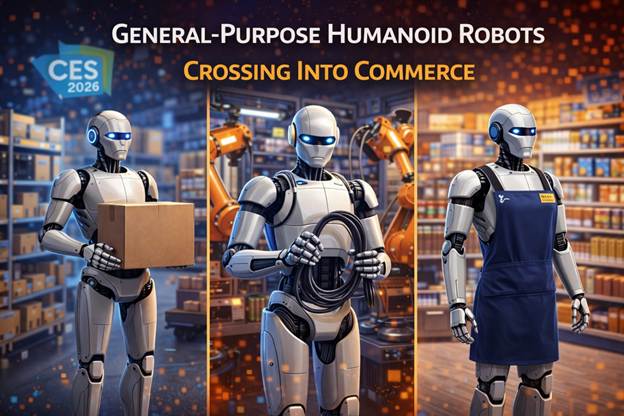
Today’s technology news from CES 2026 highlights a notable shift in humanoid robotics from research prototypes to commercially available systems. Multiple vendors announced humanoid robots designed for logistics, manufacturing support, retail assistance, and facility operations, emphasizing deployability, safety certification, and integration with existing enterprise systems. This marks a transition point as humanoid robots move from experimental showcases into economically viable products.
Why It Matters Now
The disruption lies in generalization. Industrial robots have long been effective in tightly controlled environments, but they lack flexibility. Today’s humanoid platforms are designed to operate in spaces built for humans, using AI perception, balance control, and adaptive manipulation rather than fixed programming. As labor shortages persist and wages rise, the ability to deploy robots without redesigning physical spaces fundamentally changes the adoption equation.
Call-Out
Robotics is shifting from specialized machines to adaptable labor.
Business Implications
Industries facing chronic workforce constraints, including warehousing, manufacturing, healthcare support, and facilities management, gain a new automation option that complements rather than replaces existing infrastructure. Enterprises may begin treating humanoid robots as capital assets that substitute for variable labor costs. At the same time, vendors must prove reliability, safety, and return on investment at scale. Software, training, and lifecycle support are emerging as major differentiators alongside hardware capability.
Looking Ahead
In the near term, humanoid robots will be deployed in constrained roles such as material handling, inspection, and assisted operations under human supervision. Over the longer term, improvements in autonomy, dexterity, and cost reduction could enable broader adoption across service and operational roles. Regulatory standards, insurance models, and labor policy will evolve as robots become a visible part of the workforce.
The Upshot
General-purpose humanoid robots represent a structural disruption to how physical work is automated. By operating in human environments rather than requiring purpose-built facilities, they expand the addressable market for robotics dramatically. As commercial deployments begin, the question shifts from technical feasibility to economic and organizational readiness.
References
Reuters, “Humanoid Robots Move Toward Commercial Deployment at CES 2026,” published today.
The Wall Street Journal, “Why General-Purpose Robots Are Finally Entering the Workforce,” published today.
 Disruption is a Fact of Life
Leave a comment