Introduction
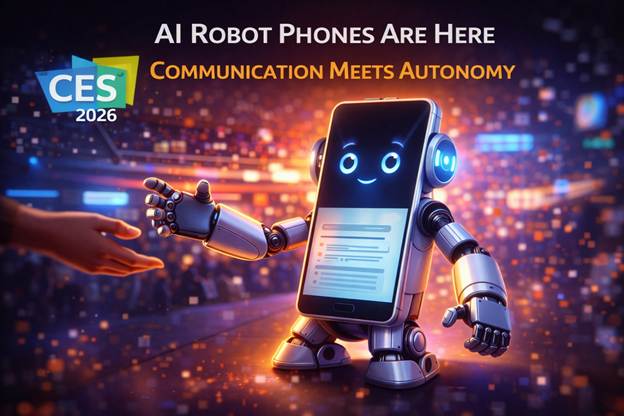
Today’s CES 2026 technology news reports the debut of the Honor ROBOT PHONE, described as the world’s first phone-robot hybrid that integrates mobile communication, advanced robotics, and AI interaction into a single device. At the same event, major display and consumer electronics companies signaled that robots and AI interfaces are becoming core parts of future product portfolios. These developments illustrate a disruptive shift in which communication devices are beginning to incorporate physical autonomy and AI-enhanced interaction. (36kr)
Why It Matters Now
The disruption lies in combining mobility, communication, and physical action into a unified intelligent platform. Traditional smartphones serve as communication portals and hubs for AI assistants, but they remain passive devices. The Honor ROBOT PHONE extends functionality by adding robotic articulation, spatial awareness, and context-sensitive interaction, blurring the boundary between mobile computing and embodied AI. Simultaneously, companies like LG Display are pivoting toward robotics and adaptive display technologies that respond to human behaviour, signalling that the next era of consumer devices will integrate physical AI components with conventional electronics. (36kr)
Call-Out
Communication devices are evolving into autonomous, interactive machines.
Business Implications
For mobile carriers and OEMs, this shift creates both opportunity and risk. Device differentiation will now involve not only performance and ecosystem integration, but also robotic capability, sensor fusion, and real-world interaction, expanding how users think about and use personal technology. Traditional smartphone manufacturers that treat communication and physical interactivity as separate domains risk losing share to entrants that merge these capabilities. This convergence also opens new software, services, and aftermarket markets around maintenance, AI interaction frameworks, and robotic hardware extensions.
At the same time, robotics companies gain access to massive existing distribution channels through partnerships with mobile brands. Enterprises in logistics, retail, and remote services could leverage these hybrid devices for tasks that require mobility, presence, and intelligent interaction with humans and environments. However, governance, safety standards, and user trust remain paramount as robots gain more agency in everyday contexts.
Looking Ahead
In the near term, hybrid mobile-robot devices will roll out in niche segments such as personal assistance, elderly care, and customer engagement, where mobility and on-device intelligence are prized. Over the long term, the distinction between communication gadgets and autonomous robots may disappear entirely, giving rise to a new category of ubiquitous AI companions that support tasks ranging from navigation, telepresence, and environment monitoring to direct physical assistance. Regulatory frameworks, interoperability standards, and ethical guidelines will evolve alongside these products to address safety, privacy, and societal impact.
The Upshot
The introduction of AI robot phone hybrids and the shift of display and consumer electronics vendors toward robotics reflect a disruptive trend: devices are no longer just tools for communication or computation; they are becoming interactive, autonomous partners in human activity. This evolution will redefine categories, user expectations, and competitive landscapes across consumer tech and robotics industries.
References
Honor presented the first “phone robot” at CES 2026, integrating AI and robotics into a mobile device, Jan. 9, 2026. (36kr)
LG Display signals expansion into humanoid robotics as robots become a visible trend at CES 2026, Jan. 9, 2026. (The Korea Times)
 Disruption is a Fact of Life
Leave a comment