Introduction
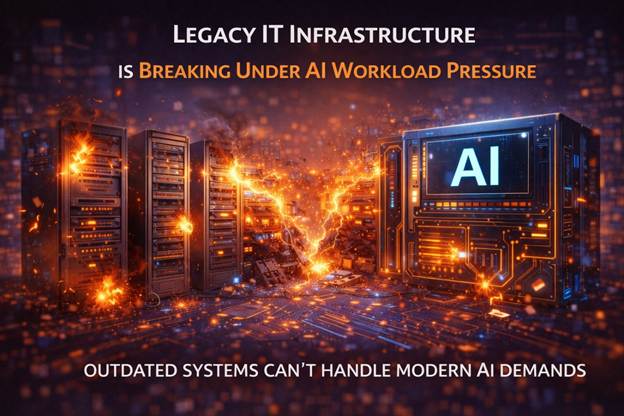
Today’s technology news reveals that as artificial intelligence becomes pervasive across enterprises, legacy IT infrastructure is struggling to meet the resilience, performance, and security demands of modern AI workloads. Newly published research from Netskope shows that a significant majority of infrastructure leaders say their current systems are not equipped for AI scale, and a separate global outlook report highlights the automation maturity gap in manufacturing, where AI adoption outpaces readiness. These reports mark a disruptive inflection point in how organizations must think about technology foundations in the AI era. (GlobeNewswire)
Why It Matters Now
The disruption lies in the mismatch between AI’s operational demands and the capabilities of traditional IT environments. Modern AI systems require continuous data flows, low-latency processing, robust resilience, and integrated security—conditions that most current infrastructure was not designed to satisfy. The Netskope research published today indicates that only 38% of infrastructure and operations leaders believe their systems can meet these needs, and even fewer are confident in their team’s readiness. This represents a structural challenge for enterprises that cannot be solved through patchwork upgrades. (GlobeNewswire)
Call-Out
AI isn’t just a software change; it is an infrastructure disruptor.
Business Implications
For CIOs and CTOs, the shift means traditional data centers, networks, and operational platforms must evolve or be replaced entirely. Enterprises that cannot support AI demands in-house will face higher costs, slower development cycles, and competitive disadvantage. The Manufacturing AI and Automation Outlook released today underscores this reality in industrial settings: although 98% of manufacturers are exploring AI automation, only 20% feel fully prepared to scale it, and many have not automated critical data flows or exception handling. (PR Newswire)
Cloud providers and technology vendors stand to benefit as organizations migrate workloads off legacy systems, increasing demand for elastic infrastructure, AI-native platforms, and managed services. At the same time, vendors that cling to monolithic legacy offerings risk becoming obsolete. The urgency of modernization is no longer optional; it directly affects operational continuity and competitiveness.
Looking Ahead
In the near term, hybrid cloud architectures, edge-augmented processing, and composable infrastructure will become standard practice as organizations seek to bridge old and new systems. Over the longer term, fully AI-ready infrastructure stacks may emerge, designed from the ground up to support continuous learning, real-time inference, and autonomous operations with built-in resilience and security protocols.
This transition will spur innovation not only in hardware and networking but also in policy frameworks, compliance standards, and workforce skill sets. Companies that invest early in resilient, AI-capable infrastructure will gain a strategic advantage in speed, reliability, and cost control.
The Upshot
The growing gap between AI demand and legacy infrastructure capability represents a structural disruption in enterprise computing. As AI becomes central to operations across industries, the ability to provide resilient, performant, and secure infrastructure ceases to be an IT backstop and becomes a core competitive capability.
References
Netskope research finds legacy IT struggling to meet AI performance, resilience, and security expectations, published January 20, 2026. (GlobeNewswire)
Redwood Software’s “Manufacturing AI and Automation Outlook 2026,” published January 20, 2026, shows high AI adoption but low automation maturity. (PR Newswire)
 Disruption is a Fact of Life
Leave a comment