Introduction
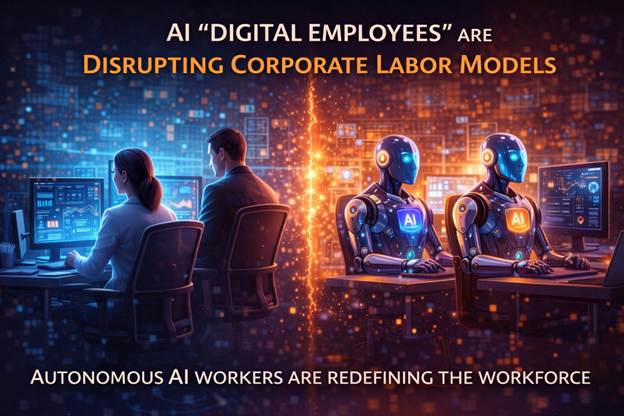
Today’s technology news reports a sharp acceleration in the deployment of autonomous AI systems described as “digital employees” or “AI workers” across large enterprises. Multiple articles published today describe companies rolling out AI systems that do not merely assist human staff, but independently execute roles in customer service, finance operations, software testing, and internal analytics. This development signals a shift from task automation to role substitution, altering how organizations define labor itself.
Why It Matters Now
The disruption lies in AI crossing a qualitative boundary. Previous generations of automation focused on discrete tasks within human-managed workflows. Today’s reporting shows AI systems being provisioned with identities, performance metrics, access controls, and accountability structures similar to human employees. As reliability improves and costs fall, organizations are beginning to redesign operating models around AI capacity rather than human headcount.
Call-Out
AI is moving from tools to the workforce.
Business Implications
For enterprises, digital employees offer scalability without hiring cycles, geographic constraints, or turnover risk. Cost structures shift from recurring labor expenses to predictable compute and licensing costs. Human workers increasingly move toward oversight, exception handling, and strategic roles rather than execution. At the same time, governance challenges intensify as organizations must ensure AI actions are auditable, compliant, and aligned with corporate policy.
Vendors providing AI workforce platforms, identity management, and monitoring tools gain strategic importance. Conversely, outsourcing firms and labor-intensive service providers face pressure as AI systems compete directly with their business models. Regulators and policymakers are also drawn into new debates over disclosure, accountability, and workforce displacement.
Looking Ahead
In the near term, digital employees will be deployed in narrowly scoped, high-volume roles with clear success metrics. Over the longer term, organizations may maintain blended workforces where AI and humans are jointly managed resources. New frameworks for AI supervision, liability, and ethical boundaries will be required as AI systems assume greater autonomy within corporate structures.
The Upshot
AI digital employees represent a structural disruption to how work is organized and valued. By redefining labor as a mix of human and autonomous agents, organizations reshape productivity models, cost assumptions, and competitive dynamics. The future of work will be determined not by whether AI is adopted, but by how deeply it is embedded into organizational design.
References
Reuters, “Companies Begin Deploying AI ‘Digital Workers’ to Replace Routine Roles,” published January 23.
The Wall Street Journal, “AI Employees Are Entering the Workplace Faster Than Expected,” published January 23.
 Disruption is a Fact of Life
Leave a comment